


Master of the forests and guardian of the natural balance
Found throughout Eurasia, the European wolf plays a key role in maintaining the balance of ecosystems by regulating prey populations such as deer and wild boar. Its grey, brown and black coat allows it to blend into its forest environment.
This canid lives in packs, usually consisting of 5 to 9 individuals, with a well-established hierarchy where each member has a specific role. It communicates through vocalisations, postures and scent markings to strengthen group cohesion and mark its territory. The wolf is an animal with exceptional physical attributes, built for running and endurance. It can run at an average speed of 8 km/h and reach speeds of up to 70 km/h.
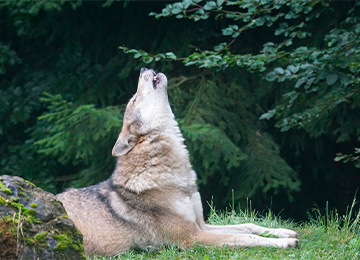
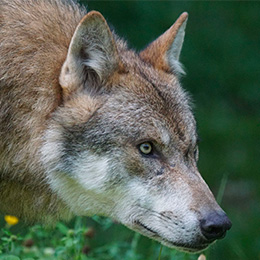
The European wolf (Canis lupus lupus) has been a protected species at international, European and French level since the 1990s. Like all large carnivores, the wolf is listed on the IUCN (International Union for Conservation of Nature) Red List of Threatened Species, with its international status currently classified as ‘least concern’. The PAL participates with other zoos in a European programme to work on the ex-situ conservation of this species.
-
HabitatThey occupy a wide variety of habitats, from Arctic tundra to forests, grasslands and arid landscapes.
-
Food
Wolves mainly hunt large prey such as elk, bison, oxen and reindeer.

An adult wolf can devour up to 9 kg of meat in a single meal, thus compensating for periods of fasting that can sometimes be prolonged.
A zoological reserve populated by Asian elephants, giraffes, lions, tigers, hippos, chimpanzees, gibbons, wolves, ostriches ... Animals evolving in their reconstituted natural environment, to discover as a family.
All animals