


A Blend of Elegance and Symbolism
The weeping willow is primarily planted as an ornamental tree. It was extremely popular in Europe during the Romantic period (18th–19th centuries). Since that time, the tree has been associated with cemeteries; in fact, Napoleon I’s tomb lies in the shade of a weeping willow. In the Far East, it symbolizes death, but also rebirth, because its branches always grow back when they are cut and replanted. In China, the tree is synonymous with immortality and communication with the heavens.



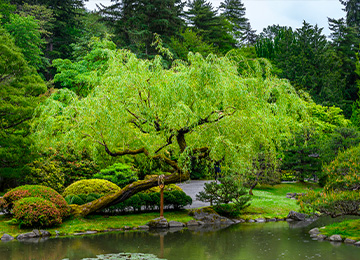
The weeping willow is undoubtedly the best-known species of willow. The ones found in European gardens are the result of a cross between Salix babylonica, which is native to Asia, and Salix alba, which comes from the temperate regions of Northern Europe. This cross has allowed it to adapt to the European climate. The weeping willow thrives in moist areas; it is said that a mature tree can consume about 400 liters of water per day. It is therefore a good idea to plant it next to a pond or water feature.

Did you know that one of France’s greatest painters, Claude Monet, painted me in several of his works? I inspired him for many of his paintings. You can even find me in his famous series of oil paintings: *The Nymphéas*
